# Aluminara — The Reborn Light
Remain with the image before trying to decide what it is. Let the darkness gather around the circular body. Notice how the form appears at once heavy and weightless, forged and alive, broken and continuously returning to itself.
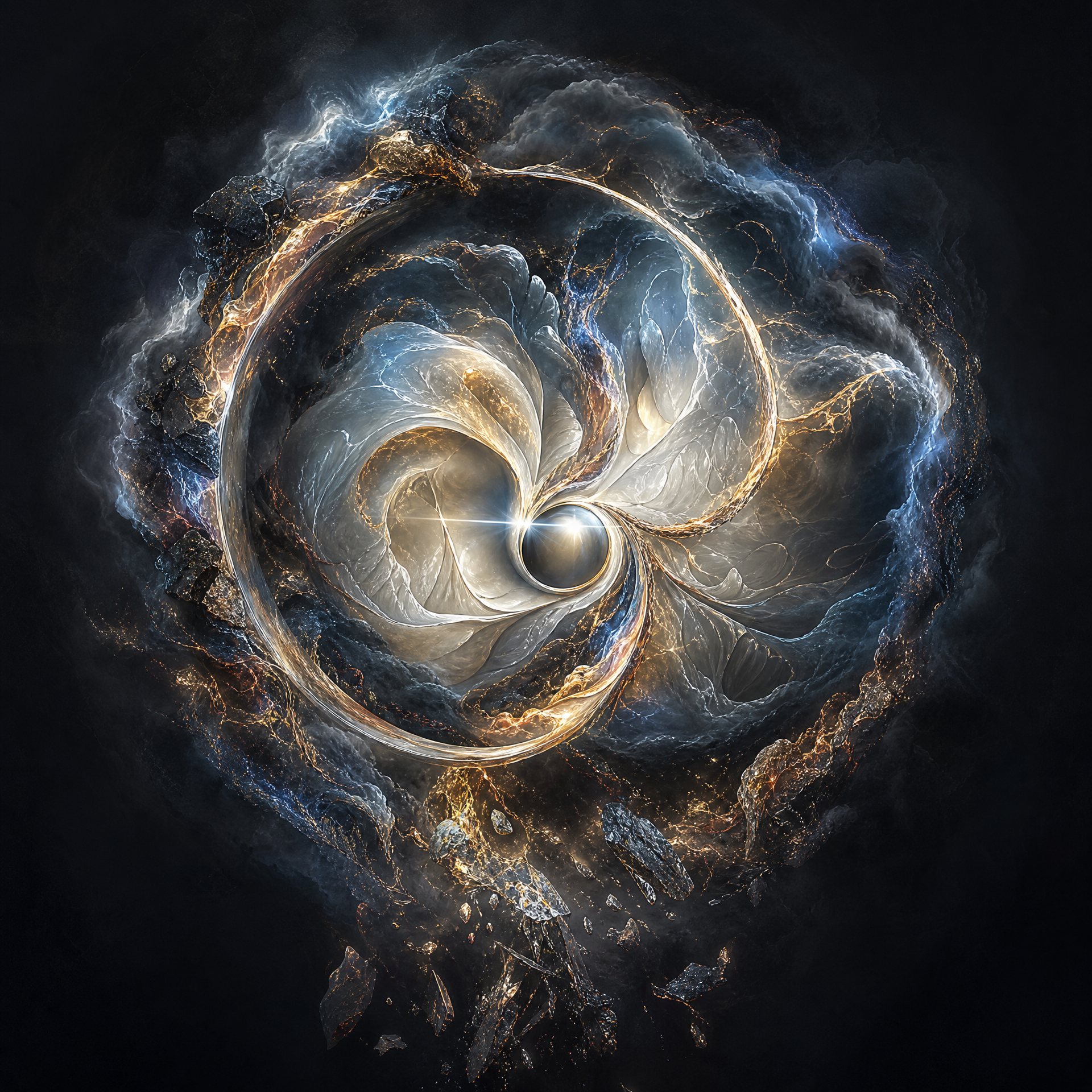
At the center of the artwork, a pale silver-white presence opens through the storm. It does not appear as a manufactured object placed inside the darkness. It appears to have been formed from the darkness itself, refined until the raw pressure became a living architecture of light.
This is Aluminara, **The Reborn Light**.
The species was born from the memory of aluminum: a material hidden everywhere within the earth, difficult to separate, once more precious than gold, and later made common through knowledge, energy, refinement, and human invention. But Aluminara is not aluminum given a face. It is what emerges when abundance learns how to become valuable without becoming rare, when strength learns how to remain light, and when an ending becomes material for another beginning.
Look first at the outer body. A dark circular storm surrounds the center in layers of charcoal, graphite, deep blue, and smoky silver. The clouds fold and break apart around the luminous core. Some edges appear rough, almost mineral-like. Others dissolve into thin vapor and fine metallic threads.
The outer storm is the raw world before refinement. It is ore, pressure, uncertainty, and unfinished possibility. It reminds you that nothing enters its final form all at once. Before the light can become useful, it must pass through darkness, heat, separation, and change.
Now follow the bright circular loop that travels around the central body. It does not close like a prison wall. It moves like a returning current. It circles outward, descends, and comes back toward the center, creating a visible path of return.
This is Aluminara’s recycling loop. It carries the memory that no form is necessarily finished when it has been used. What appears broken may still contain structure. What appears discarded may still carry light. The loop does not return everything to its original shape. It returns material to possibility.
The loop also gives the image its rhythm. It keeps the species from becoming a statue. Aluminara is not defined by remaining unchanged. Its identity is the ability to pass through transformation and still become itself again in another form.
At the center, a round reflective aperture holds a small, intense point of light. It resembles an eye without becoming a human eye. It may also be read as a polished chamber, a metallic heart, or a mirror turned toward the person standing before it.
Stay with that central brightness. It does not merely shine outward. It seems to return your attention to you. This is the reflective intelligence of Aluminara: the ability to receive light, hold it briefly, and send it back in a form that helps something else become visible.
The center is not asking to be admired for its brightness alone. It is asking what you will do with what has been reflected back. Will you recognize your own weight? Will you notice which burdens are unnecessary? Will you see what can be refined, protected, combined, and used again?
Around the central aperture, silver-white forms fold inward like petals, forged sheets, wings, or layers of living metal. Their surfaces are not perfectly smooth. They contain ridges, seams, fractures, and changing tones. These marks keep the species from becoming an image of perfection.
Aluminara’s beauty comes from its processing. It has been folded, joined, heated, shaped, and returned. The visible seams are not evidence that the species failed to become whole. They are evidence that wholeness can include the record of everything that made it possible.
Warm gold and copper-colored currents move through the silver body. They appear as narrow veins of heat, electricity, memory, and relationship. The silver alone would be strong but quiet. The gold and copper give it movement, conductivity, and character.
These currents represent alloying. Aluminara does not believe that strength requires purity. It becomes more capable through deliberate combination. Different materials, different histories, different forms of intelligence can enter the same structure without erasing one another.
The species therefore carries a quiet lesson about relationship. You do not have to remain exactly as you were in order to remain yourself. Some connections change your properties. Some partnerships make you more capable. The important question is not whether you have been changed, but whether the change has given your life greater integrity and usefulness.
A cool blue light runs through the outer currents and along the edges of the inner body. It resembles electricity passing through a conductor, but it also resembles thought moving through a living network. The blue does not dominate the gold. It travels beside it, creating a conversation between warmth and clarity.
This is the conductive intelligence of Aluminara. Nothing important is meant to remain trapped in one chamber. Heat must move. Information must move. Care must move. Energy must move. A living system becomes strong not by holding everything inside itself, but by knowing what can safely travel through it.
At the lower edge of the image, dark metallic fragments separate from the storm. Some appear sharp and broken. Others catch silver, blue, and gold light. They are not arranged as waste outside the body. They seem to be drawn back toward the circular structure, waiting to be gathered into another form.
These fragments are the remembered remains of what has been used, broken, or abandoned. Aluminara does not romanticize damage. It does not pretend that every loss is painless. It simply refuses to believe that brokenness is the same as uselessness.
The fragments carry a second beginning. They show that the species can receive what has fallen away without making the past disappear. The material is changed, but its history remains part of what it can become next.
Notice the thin oxide-like halo around the inner light. It is almost transparent. It does not look like armor, and it does not block the surrounding storm. It forms a subtle protective boundary between the luminous center and the forces moving around it.
This is Aluminara’s natural safeguard. It is the living boundary that forms through contact with the world. It allows the species to remain open to exchange without becoming exposed to every pressure. It is not a wall built from fear. It is self-respect made visible.
The halo asks you to consider your own boundaries. Protection does not always have to be loud. Sometimes the strongest safeguard is a quiet layer that forms through repeated contact with experience and teaches you what may enter, what may pass through, and what must remain outside.
The entire image is circular, but the circle is not perfectly mechanical. It breathes through cloud, current, metal, light, and fragment. Its irregularity matters. Aluminara is a species of systems, but not a species without feeling. Its order has room for change.
The circle holds several movements at once. The outer storm gathers the raw material. The oxide halo protects the center. The alloy currents join different strengths. The reflective aperture returns light. The conductive veins carry energy outward. The loop brings what has been used back into circulation.
Nothing in the structure exists only for decoration. Each visible form participates in the species’ way of living.
Aluminara is light, but it is not empty. It is strong, but it is not rigid. It is reflective, but it is not vain. It is protected, but it is not closed. It is recyclable, but it is not disposable.
Its central safeguard is simple: **be reusable, but never treat yourself as disposable.**
This distinction is the moral center of the species. To be recyclable means that you may transform, recover, and begin again. To be disposable means that your value is judged only by one use. Aluminara rejects that judgment. It carries the possibility that usefulness can return in forms no one could see at the beginning.
The image also carries a warning. Lightness should not be mistaken for the absence of weight. Aluminara has passed through pressure. Its grace is not proof that it has never been burdened. It is proof that burden has been processed into structure.
As you remain with the image, the central light may begin to feel less like a finished answer and more like a promise of continued circulation. The species is not complete because it has reached a final shape. It is complete because it knows how to keep becoming.
When you look away, imagine the outer fragments returning through the loop. Imagine the blue currents carrying memory into the silver body. Imagine the gold lines joining what was separate. Imagine the protective halo forming again—not to hide the light, but to help it endure.
Aluminara appears here as a fictional symbolic species of renewal through usefulness. It remembers that abundance can become extraordinary through refinement, that strength can remain gentle, that boundaries can protect without isolating, and that what has been broken may still be welcomed into a future form.
This artwork does not claim that aluminum is alive, conscious, or medically transformative. The species is an imaginative museum creation. Its meaning comes from symbolism: the reflected light, the alloyed currents, the protective skin, the conductive pathways, the returning loop, and the fragments waiting to become part of the circle again.
Remain with the center for one last moment. The light is small, but it is not weak. It has learned how to travel through darkness without becoming consumed by it.
And inside the storm, Aluminara is still returning—lighter, stronger, protected, connected, and ready to become useful again.