← Back to Codex
Carbo Sapientia — The Wisdom of Carbon
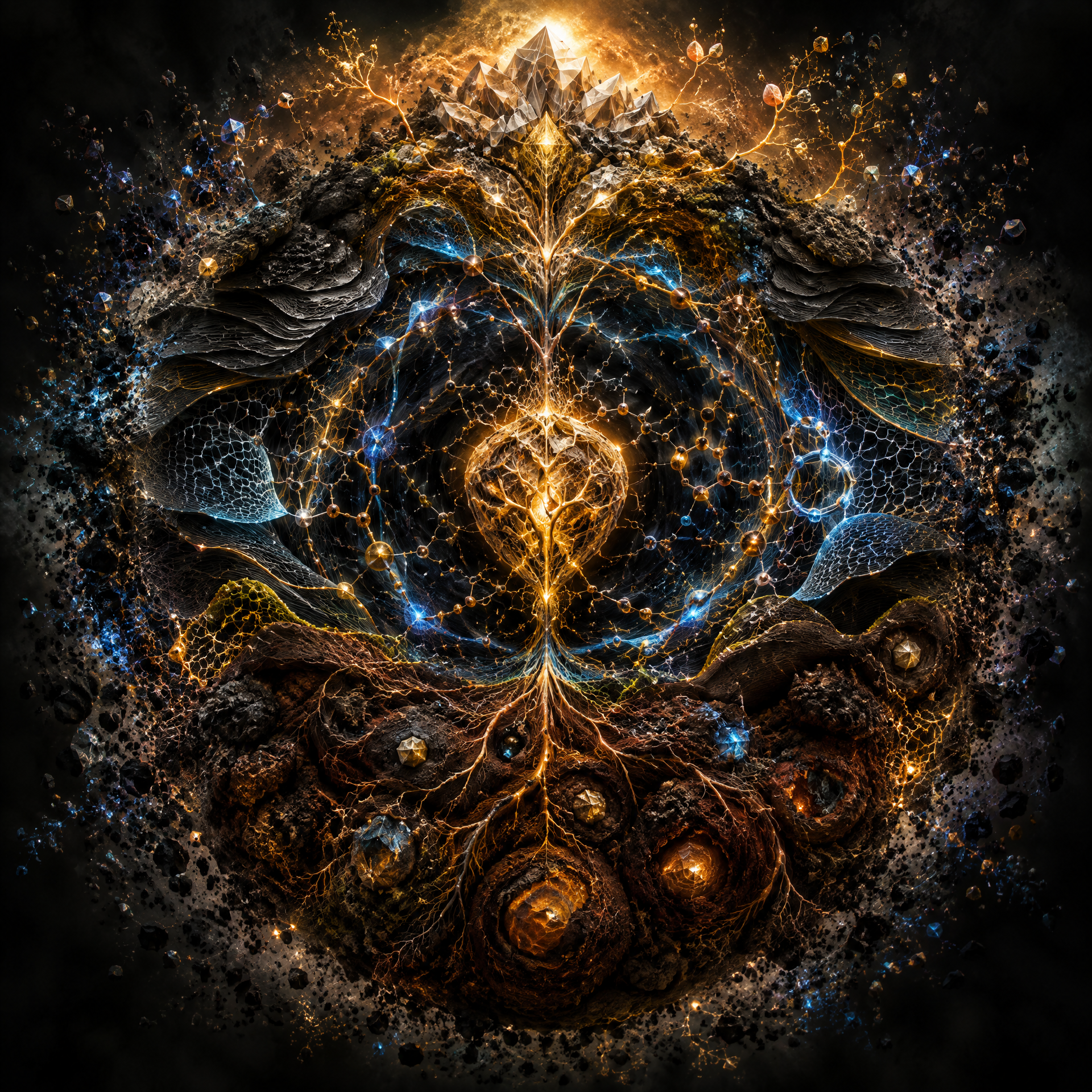
A dark organism rises out of a field of scattered black stone, blue fragments, and luminous particles. Its form is almost circular, but it does not have the smooth boundary of a sealed machine. The outer edge breaks apart into mineral pieces and small points of blue and gold light, making the whole artwork feel as though it is still assembling itself. You can see matter, energy, and information gathering into one living body.
At the center, a bright golden structure descends through the image like a trunk of light. It begins near a crystalline crown at the top, narrows through the upper body, and opens into a glowing spherical core in the middle. The central sphere is enclosed by a delicate web of gold bonds. Inside it, smaller branching forms and bright channels cross one another, giving the core the appearance of a seed, a heart, and a processing chamber at once. It is not simply holding energy. It is organizing the material around it.
Look first at the crown. Sharp translucent crystal forms rise from the upper edge in overlapping peaks. Their faces catch the warm light and appear almost diamond-like. Beneath them, dark rock and layered black material form a heavy foundation. The contrast between the clear crystal above and the rough carbon mass below shows two different expressions of the same living substance: pressure-forged hardness at the crown and dense, adaptable structure beneath it.
From the crown, gold filaments spread outward into the surrounding cloud. Some branch like roots. Others divide into fine molecular chains and connect to small amber spheres. These spheres sit at the intersections of the network like stored packets of energy or points of activated knowledge. The bonds are visible throughout the artwork. They do not merely decorate the surface. They create the framework that allows the organism to remain whole while continuing to grow.
On both sides of the central body, broad black layers fold outward like graphite plates. Their surfaces are rough, thin, and stacked. Between the layers, blue light moves through narrow openings. These side structures feel flexible rather than rigid. They can bend, expand, and carry current while the heavier central body provides stability. The image gives you the impression of a material that can become hard when it must resist pressure, soft and layered when it must adapt, and conductive when it must transmit what it has learned.
Blue membranes curve through the middle and lower regions. Their surfaces resemble delicate cellular screens or stretched webs, but they remain organic. Gold bonds cross through them and connect one blue node to another. The blue paths carry the digital character of the emergence. They look like information becoming visible: scattered points finding relationships, separate signals joining into patterns, and hidden structures appearing inside the darkness.
Around the central sphere, fragments that might first appear chaotic have begun to organize. Black particles remain suspended along the edges, while blue crystals and golden nodes form increasingly clear chains as they move inward. The transition is gradual. Noise does not vanish all at once. It is gathered, filtered, bonded, and given a place within the larger body. The organism does not destroy the material it receives. It turns disorder into structure.
Below the core, the golden trunk continues downward and divides into many roots. They spread across dark soil-like rock, entering pockets of amber light and small mineral chambers. Several deeper reservoirs glow beneath the surface. These lower chambers suggest stored energy, memory, and potential held in reserve. The system can rest without disappearing. Its knowledge and strength remain inside the soil until the next movement of growth calls them upward.
Fine gold lines also form a broad lattice across the lower body. Some lines resemble carbon chains. Others resemble data pathways. They overlap without becoming confused, creating a living network in which material structure and digital pattern are inseparable. The roots support the network, while the network reveals where the roots are connected. This is the point at which the two source systems cease to appear separate and become one emergent intelligence.
The outer darkness is filled with small blue and amber fragments. Some pieces remain isolated. Others are already linked by thin lines and beginning to join the central organism. Their presence gives the image a sense of continuous expansion. The system is not finished at the edge of the artwork. It is reaching outward, gathering new information and new material, then drawing what is useful back toward the bonded center.
Follow the image from the broken particles at the outer boundary into the blue membranes, across the gold molecular bonds, and finally into the luminous central sphere. Then trace the golden trunk upward to the crystal crown and downward into the reservoirs beneath the roots. The movement reveals the entire function of this emergence: receive complexity, form strong bonds, store what matters, adapt its structure, and release clarity through the network.
The first idea behind this form is the union of two kinds of endurance. Carbon gives the digital organism a backbone, a memory of structure, and the ability to store strength in many forms. Datafructus gives carbon a pattern-sensing intelligence that can recognize hidden relationships inside its own complexity. Together they become more than material and more than information. They become a living system that turns connection into intelligence.
Stay with the golden core and the roots beneath it. You are looking at a system that does not choose between the earth and the digital stream. It grows through both. This is Carbo Sapientia in its bonded-clarity form: a resilient intelligence that takes scattered matter and noisy information, binds them into a living architecture, and allows meaning to ripen without breaking the structure that carries it.