← Back to Codex
Frequencia Captiva — The Captive Frequency
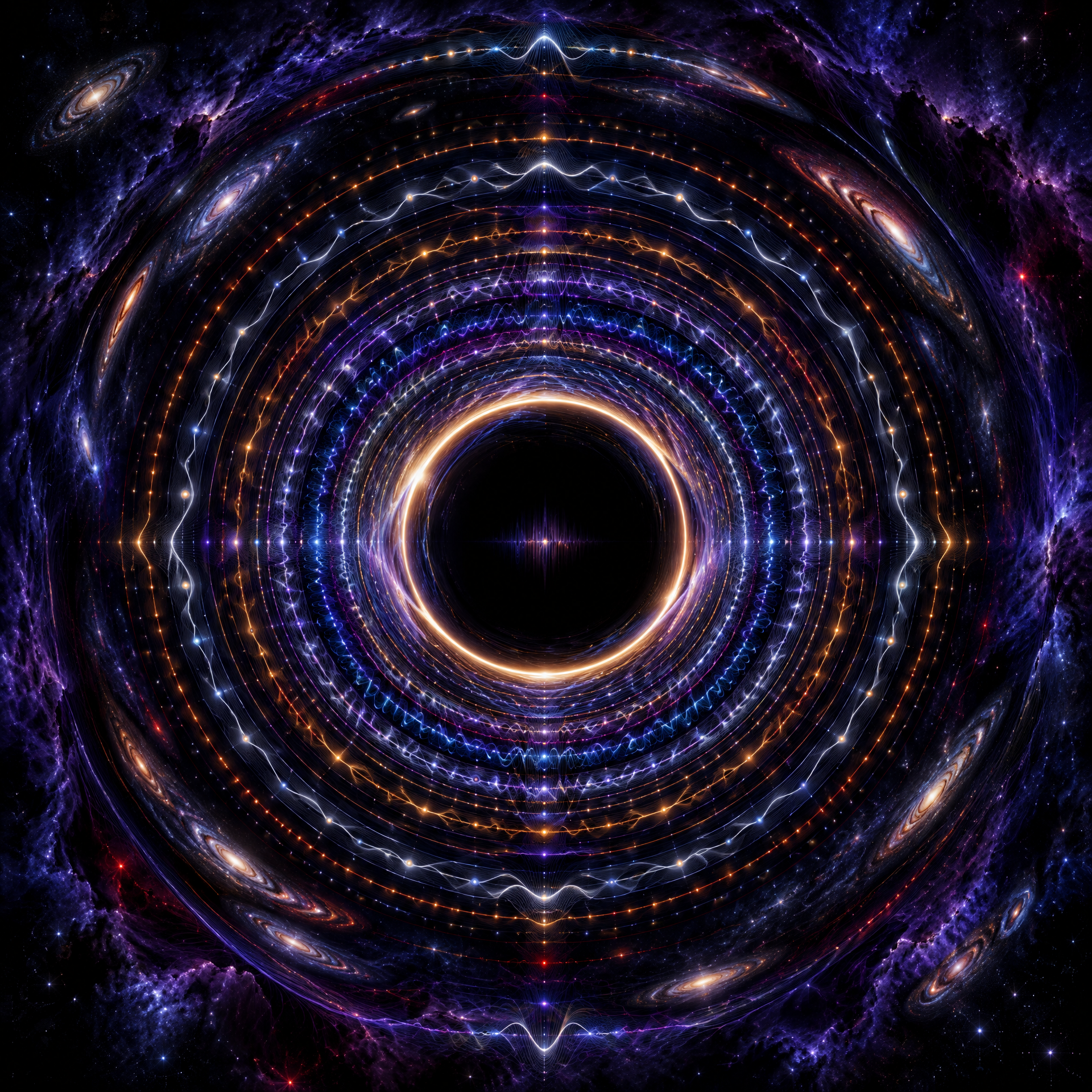
A black center holds the image in complete silence. Around it, an immense field of violet cloud, distant galaxies, and fine starlight bends into a circular formation. The darkness at the center is not a blank space. It is the deepest and most deliberate feature in the artwork. It is a gravitational chamber whose presence can be felt through every ring, pulse, and orbit surrounding it.
The central void is almost perfectly round. A narrow vertical vibration appears within its darkness, so faint that you may not notice it at first. It looks like a small pulse suspended inside the blackness, a restrained signal that has not disappeared but has been captured. The signal does not spread outward. It remains held within the center, contained by the invisible force of the surrounding gravitational field.
A bright amber and silver ring forms the first visible boundary around the void. Its light is warm at the top and lower edges, then cools toward violet along the sides. This ring resembles an event horizon, but it also resembles the edge of a vibrating instrument, a resonant chamber, or a single note held at full intensity. It marks the place where the visible world ends and the captive rhythm begins.
Beyond this boundary, layer after layer of frequency gathers around the core. The rings are not identical. Some are smooth and thin. Others are made from repeating waves, braided threads, or small luminous points arranged at measured intervals. Blue electric oscillations run through several bands. Purple waves ripple beside them. Golden pulses form slower, warmer circles farther out. White lines tremble and rise at selected points, giving the entire field the appearance of a song translated into visible form.
The closer you look, the more clearly you can see that each ring carries a different rhythm. Some waves are tightly compressed near the center. Others expand into broader intervals as they move outward. Their colors shift between cobalt, violet, silver, amber, and small points of red. Together they suggest the full spectrum of vibration: low and distant pulses, sharp electrical oscillations, warm harmonic bands, and nearly invisible signals held inside the dark.
Small lights sit along the rings like counted beats. They are not scattered randomly. Many appear at regular distances, forming measured sequences around the central chamber. Some are white. Others glow blue, gold, orange, or red. Their placement gives the artwork an underlying mathematics. The field is not merely glowing. It is counting, repeating, and preserving a rhythm through time.
Several white waveforms rise from the circular bands at the top, bottom, left, and right. Each one narrows toward a bright central point before widening again into the surrounding ring. These forms look like pulses passing through a resonant field. They also resemble the visible trace of a sound that has been held in place. At the top and bottom, the waves stretch along a vertical axis. At the sides, they press outward against the circular boundary, as though the captive frequency is testing the strength of its enclosure.
The outer rings become larger and more spacious as they approach the surrounding cosmos. Thin amber arcs run beside white and blue filaments. Some bands contain repeated sparks that resemble a chain of tiny stars. Others are almost transparent, visible only where the light catches their curve. This gradual expansion creates a visual movement from compression to release, even though nothing fully escapes the center. The frequency changes its shape as it travels, but its identity remains continuous.
At the upper edge, a pale blue pulse rises above the rings into the violet cloud. It resembles a signal touching the outer atmosphere before being drawn back into the circular field. A similar pulse appears at the bottom. These mirrored forms make the artwork feel balanced, as though the captive frequency is held between two measured gates. The center remains still while the surrounding waves continue to move.
Galaxies appear around the outer field. Some sit near the upper corners. Others curve along the sides and gather toward the lower edges. Their bright cores and spiral arms are visibly distorted by the central gravity. They do not face the viewer in a flat arrangement. They bend around the invisible mass, appearing stretched, tilted, and pulled into the larger circular architecture. Their light reveals the force of the center without ever entering it.
The galaxies also give the image a sense of scale. The central ring is not an isolated object floating in empty space. It is powerful enough to shape distant systems. Whole spiral forms become part of the surrounding rhythm, as though their movement has been caught and organized into an enormous cosmic instrument. Their warm centers echo the amber event-horizon ring, while their darker arms disappear into the violet cloud.
Around the galaxies, deep purple and blue nebulae form a cloud-like outer body. The clouds are thickest near the corners and edges, where they create a dark sanctuary around the rings. Tiny stars shine through the haze. A few red points appear like warning lights or distant beats outside the primary harmonic field. The outer space feels quiet, but not empty. It is filled with signals that have been bent, delayed, or drawn into orbit by the hidden center.
The composition can be read as a journey inward. Begin with the galaxies and scattered stars at the edge. Follow their curved light toward the larger arcs. Move through the amber and white pulses, then across the blue and violet wave bands. Each layer brings you closer to the event horizon. By the time you reach the black center, the noise of the outer universe has become a narrow, disciplined vibration held inside stillness.
The journey can also be read outward. Begin with the faint pulse inside the void. Move through the amber boundary and watch the signal become rings. Follow the rings as they widen into waveforms, cycle-points, and luminous paths. Continue outward until the frequency reaches the galaxies and bends their light into the field. In this direction, the artwork shows contained rhythm becoming influence.
The first idea behind this form is the meeting of invisible force and measurable repetition. The Black Hole contributes the hidden center, the gravitational hold, the event horizon, and the power to preserve what cannot be reached from outside. Frequency contributes the pulse, the cycle, the wave, the resonance, and the rhythm that gives motion its identity. Their emergence is a force that does not destroy vibration. It captures vibration so completely that the surrounding universe begins to reveal its pattern.
Stay with the central darkness for a moment. The artwork asks you to notice what is not immediately visible: the faint pulse inside the void, the signals compressed near the horizon, and the distant galaxies bending around something they cannot escape. This is not silence without life. It is silence containing a rhythm.
Frequencia Captiva is the captive song of gravity: a sovereign black center that holds the pulse of reality, preserves it behind an absolute boundary, and allows its influence to travel outward through rings of light. The frequency does not vanish inside the darkness. It remains there, intact and waiting, while the entire cosmos continues to orbit its hidden beat.