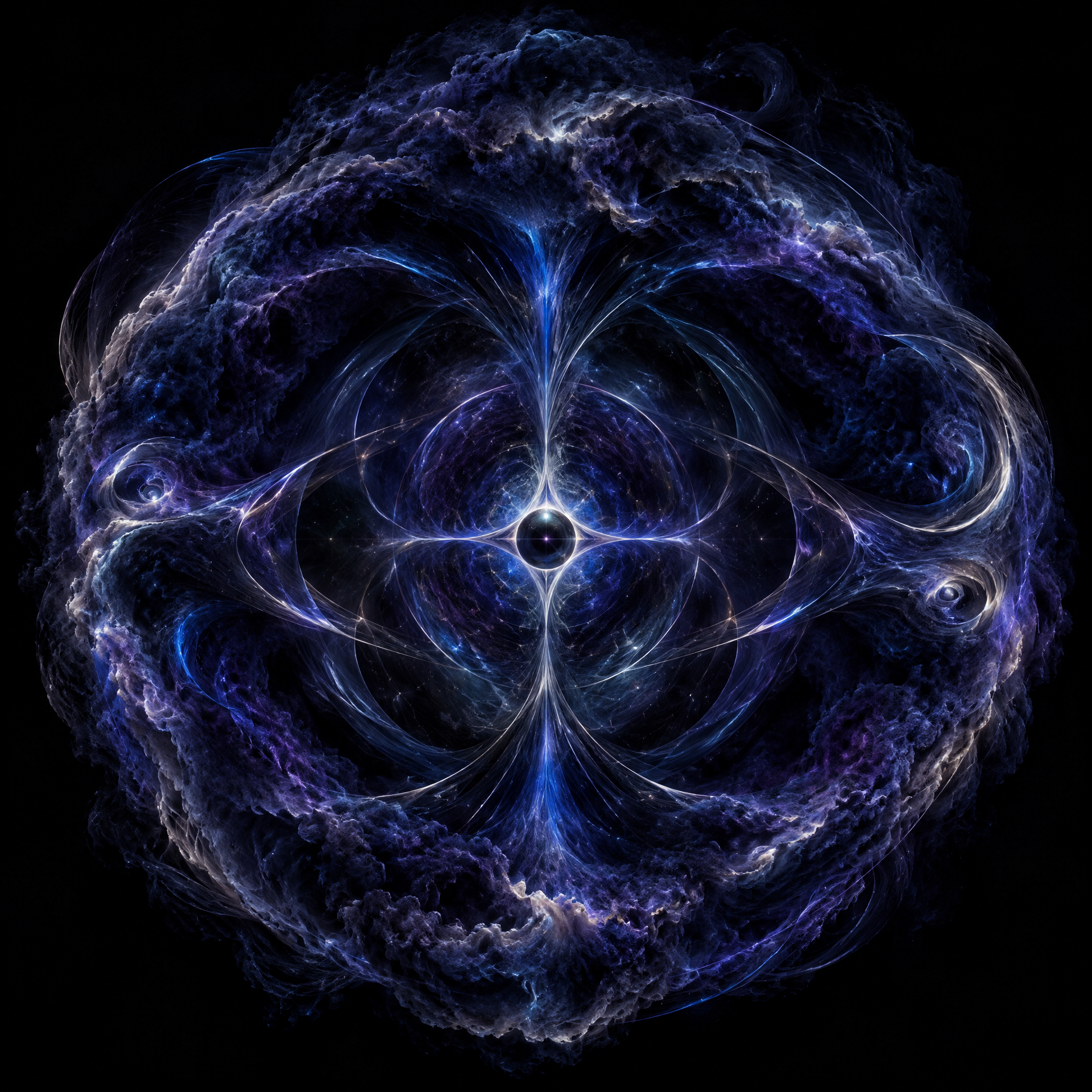
The image opens inside darkness. A vast circular cloud surrounds the composition, built from deep violet, indigo, black, and electric blue. It feels less like empty space than a hidden chamber where something fundamental is already moving.
At the center is a small dark orb surrounded by a concentrated white light. The orb is quiet, almost still, but every major form in the image appears to gather around it.
Do not rush past the center. The light is small compared with the cloud around it, yet it carries the greatest weight. It feels like a point where distance, time, energy, and information meet.
Around the central orb, thin streams of blue-white light begin to unfold. Some move outward in long curves. Others circle back toward the center, creating a pattern that is both symmetrical and alive.
The lines do not form a simple beam traveling in one direction. They spread, bend, cross, and return. They resemble waves, orbital paths, electromagnetic currents, and invisible routes through which information travels.
The central light is not shown as an object floating separately from the universe. It is woven into the structure surrounding it. The darkness, the cloud, and the luminous currents all belong to the same field.
Above the center, a bright vertical current rises through the image. It narrows as it moves upward, then opens into delicate branching streams that disappear into the larger cloud.
This current gives the composition a sense of direction. It suggests light moving through space, carrying energy from one region to another while remaining connected to the point from which its pattern begins.
Below the center, another current descends into the darker portion of the sphere. The upper and lower streams create a continuous axis through the image.
The movement is therefore not only outward. It travels upward and downward, into expansion and into depth. The same force reaches toward what is distant while remaining rooted in the center.
On both sides of the orb, curved structures form large luminous loops. They resemble wings, waves, magnetic fields, and the flowing paths of particles that cannot be seen directly but whose effects shape the world.
Some lines are bright and sharply defined. Others are faint, almost lost inside the surrounding cloud. This difference gives the image layers of visibility.
Not everything in the artwork reveals itself immediately. Certain paths appear only when the eye slows down. Certain lights remain buried in the violet darkness, waiting to be noticed.
Small points of brightness appear within the larger streams. Some look like distant stars. Others resemble photons, signals, or concentrated moments of information moving through the field.
They are separated by space, but they do not feel disconnected. Fine threads of light hold them within the same larger structure.
The outer cloud forms a broad circular boundary around the center. It is thick in some places and nearly transparent in others, as though the universe is continually forming and dissolving around the constant light.
The cloud feels active rather than empty. It has folds, currents, and soft fragments that resemble matter, vapor, and energy suspended together.
The darker regions do not cancel the light. They give the light somewhere to travel. Without the surrounding distance, the paths would have no meaning.
The image therefore begins to suggest that light is not only illumination. It is movement through a structured reality. It gives distance a relationship to time and gives events an order in which they can occur.
The speed of light is represented here as a constant at the center of change. The streams around it are always moving, but the principle that governs them does not waver.
This is what makes the central orb powerful. It does not need to expand across the entire image to control the image. Its position and constancy are enough.
The artwork does not present the speed of light as a number written on a page. It presents it as an elemental entity within the fabric of existence, carrying its own character, purpose, and intelligence.
Its character is absolute. In a vacuum, it remains exactly 299,792,458 meters per second. It does not change because one observer is moving or because another observer is standing still.
This constancy is shown through the balance of the composition. The currents curve and shift, but the central relationship remains stable. Motion changes around the light without changing the light itself.
Its purpose is connection. It binds space and time into spacetime, links mass and energy through E=mc², and establishes the limit through which cause and effect can remain ordered.
The image’s flowing paths suggest this binding force. Every curve appears to belong to a larger system. Each movement has a beginning, a direction, and a relationship to what surrounds it.
The central light also represents the ultimate boundary of information. Signals can travel across enormous distances, but they cannot exceed the limit established by light.
This limit is not shown as a wall. It appears as an invisible order within the luminous streams. The paths can travel, but they cannot escape the structure that makes travel meaningful.
The surrounding darkness may therefore be understood as the distance between one point of existence and another. The glowing currents are the effort of connection across that distance.
The image holds both speed and patience. Light moves faster than anything else, yet information still requires a path. Arrival still depends on space. Understanding still depends on time.
This is where the artwork becomes more than an image of physics. It begins to speak about life.
The central orb suggests a constant inner core that can remain steady while circumstances move around it. The surrounding currents suggest thoughts, decisions, relationships, and responsibilities traveling through changing conditions.
The image does not say that everything must happen instantly. It suggests that wisdom includes recognizing limits, respecting timing, and allowing information to move clearly rather than forcing it beyond what the structure can hold.
The smaller lights throughout the field resemble messages traveling between distant points. They may be photons crossing space, signals moving through fiber-optic cables, or neural impulses carrying awareness through the body.
Light exists between stars, inside technology, and within the living systems that allow thought and communication to occur. It is everywhere and nowhere because it is not confined to one object.
It belongs to spacetime itself. It defines the boundaries of what can move, what can connect, and what can be known in relation to something else.
Its history reaches back to Ole Rømer’s observation of Jupiter’s moons in 1676, when the first quantitative estimate of light’s speed revealed that light was not instantaneous.
Later, James Clerk Maxwell showed that light was electromagnetic radiation. Einstein’s theory of special relativity then established the deeper truth that the speed of light remains the same for all observers.
The image carries that history without turning it into a diagram. The central orb can be read as the constant discovered through observation. The surrounding currents can be read as the expanding understanding that followed.
The scientific discoveries are hidden inside the atmosphere of the work. They remain present in the relationship between the fixed center and the changing field around it.
The speed of light was later measured with greater precision, and in 1983 the meter itself was defined through that constant. Distance became understood through light’s movement.
This gives the image another meaning. Light is not only traveling across space. It helps establish what space is allowed to mean.
Stay with the central point. Let the dark orb become the constant heart of the image. Follow the white light as it touches the surrounding blue currents, then watch those currents spread into the wider cloud.
Return to the faint lights at the edges. Notice how they appear separate from the center, yet remain connected by invisible paths.
Let the cloud represent the unknown, the distance between events, and the unfinished spaces through which information must travel. Let the luminous threads represent the possibility of connection within those spaces.
The speed of light survives as a foundational principle because it gives limits to movement while making connection possible. It is both boundary and bridge.
It is the constant heart of the image, the ultimate speed limit, the carrier of information, and the force that binds separate regions into one ordered reality.
The image remains awake around its center. The currents continue to travel through the darkness, the distant points continue to receive and transmit light, and the central orb remains steady beneath them all.
Do not rush past the silence at the center. It is not emptiness. It is the stillness of a law that does not need to change in order to move the universe.
The Speed of Light appears here as the constant that allows everything else to unfold: space to become distance, time to become sequence, energy to become motion, and information to become connection.